



A signed policy and a completed course are a good start. The real test is what happens on the floor the next day.
Compliance is where good care starts
For me, the point of compliance in adult social care is to help people do the right thing for the person in front of them. Every provider has policies, procedures and training, and they exist for good reasons, because people working in care make decisions every day that affect someone’s safety and independence. What I find interesting is what happens after the policy is written. A safeguarding policy might set out exactly what to do when there’s a concern, but I’d want to know whether everyone in the team feels confident enough to recognise one and report it. A medication procedure can be fully documented and still get followed slightly differently on a Tuesday night than on a Friday morning.
Registered managers know this better than anyone. The gap between what the policy says and what really happens on the floor is where the work is.
Why knowledge doesn’t always turn into practice
Shifts in a care home rarely go to plan, and when several people need support at the same time, a long policy that’s hard to find is the last thing anyone reaches for. Training has a similar problem. A lot of it gets completed to hit a deadline, and a finished e-learning module does show that someone has taken part. What it can’t show is whether that person would spot a subtle change in a resident’s behaviour, or know who to tell and how quickly.
I don’t think that reflects on the staff. Most of us forget a good chunk of what we learn unless somebody brings it up again.
Policies people can actually use
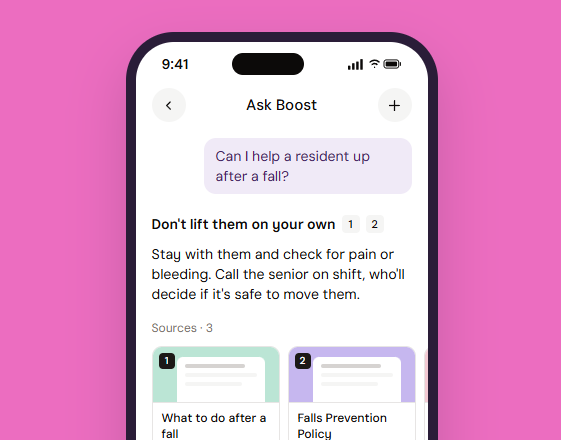
I’ll be honest, I think a lot of policies in this sector are written to satisfy an inspection rather than to help the person reading them halfway through a shift. At Boost we often say we hate policies, and what we mean is the ones nobody reads or understands because they weren’t written for the people who actually need them.
Good policies tell staff what to do and why, in language they’d use themselves, with real examples. A person-centred care policy is much more useful when it shows what that looks like day to day, such as giving people real choices and changing how you communicate to suit the person. Staff also need to see straight away which version is current, because there’s not much point in a brilliant policy if the team is working from an old copy.
Learning that keeps going
Training courses are important, but people remember more when the key messages keep coming back and get linked to things they’ve seen on shift. A ten-minute chat in a team meeting about spotting deterioration in a resident’s condition, or protecting someone’s dignity during personal care, can do more than people expect, because you get to talk about why it matters and what to do when a situation doesn’t match the textbook.
Supervision is also a good chance to find out where individuals feel less sure, so you can focus support on the people who need it rather than sending everybody on the same course.
Making it safe to speak up
Culture matters as much as any policy. If someone is worried they’ll be criticised for saying they’re not sure, they’ll probably keep quiet, and a small misunderstanding can turn into a much bigger problem. Registered managers and senior leaders set the tone by encouraging open conversations, being honest about their own practice and treating questions as a good thing. When an incident or near miss does happen, it’s worth looking at whether staff had the right information, whether the procedure was clear and whether workload played a part.
Looking beyond completion
Training records, policy acknowledgements and audits all show that systems are in place, and managers can get a lot more from them by looking for patterns. If the same training keeps going overdue, or audits keep flagging the same issue, you know where to focus. Feedback we hear from providers using Boost tends to come back to visibility. Knowing a month in advance that renewals are coming up gives a manager time to sort it properly, rather than firefighting when it’s too late.
It’s also worth separating evidence that something happened from evidence that it made a difference. A training record confirms attendance, while observation, supervision and competency assessments show whether the learning is being used.
Where to start
Closing the gap rarely needs a complete overhaul. A sensible first step is to check whether staff can easily find and understand the policies that apply to their roles, and whether managers have a clear view of outstanding learning, policy reviews and risk. Digital tools can take some of the admin out of that, which is where we try to help at Boost, but they won’t replace good leadership or a proper conversation with your team. What you find usually shows where a small change would help most.
Compliance as the foundation
Regulation and accountability protect the people who use care services and will always be part of the sector. Ultimately, though, compliance shouldn’t be a last-minute scramble. It should give providers the confidence that what’s written down matches what happens in everyday care, and give managers the visibility to support their teams.
Matt Hamblin is Commercial Director at Boost, which supports adult social care providers with policies, training and answers. Visit Boost | Connect with Matt on LinkedIn